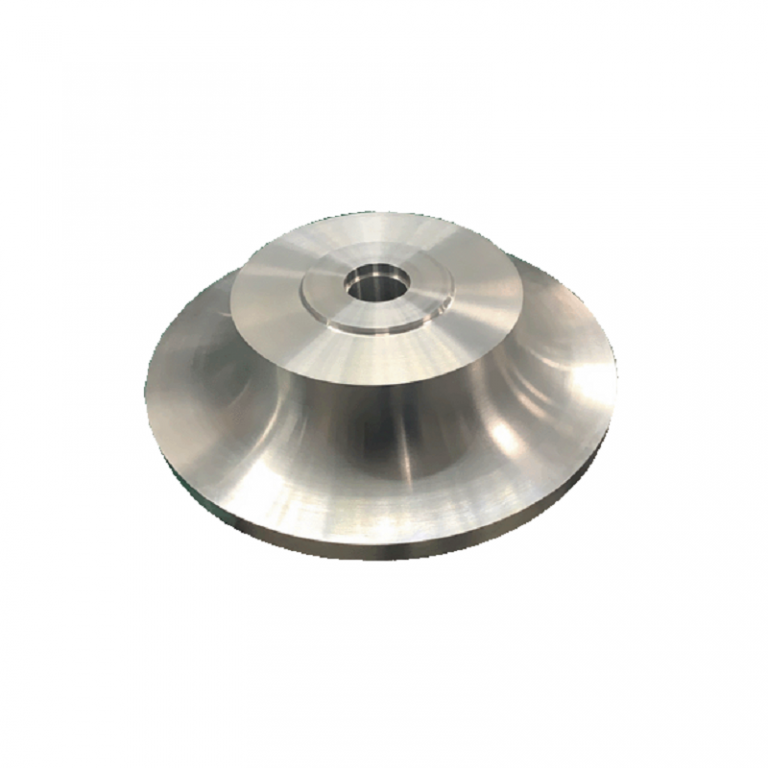
Preturn Used to Make Centrifugal Impellers
"Preturn" in the context of centrifugal impeller manufacturing is a critical preparatory phase. It sets the foundation for the entire machining process, impacting final part quality, tool life, cycle time, and cost.
Here is a comprehensive guide to the Preturn for a Centrifugal Impeller, broken down into logical stages.
Core Objective of the Preturn Phase
To transform a raw material blank (forging, casting, or bar stock) into a precisely positioned and pre-machined "semi-finished" part, ready for the complex multi-axis machining of blades, hub, and shroud surfaces.
Key Considerations & Best Practices
Fixturing is King: The preturn must create datums that allow for a rigid, repeatable, and accurate fixture setup on the 5-axis machine. Any error here compounds.
Stress Relief: For materials like titanium, an intermediate stress relief heat treatment may be required after rough machining to prevent distortion during finishing.
Tooling Strategy: Use robust, high-throughput tools for roughing (insert cutters, corn cob mills). The preturn is about efficiency.
Inspection at Every Stage: Verify dimensions after turning, and after rough/semi-finish milling using CMM or on-machine probing.
Software: CAM programming for the preturn milling (pocketing) must be tightly integrated with the final blade-finishing toolpaths.
Preturn Checklist Summary
Raw Material: Certified near-net-shape forging.
Primary Datums: Precision bore and front face machined.
Angular Datum: Precision target/notch for blade alignment machined.
Bulk Removal: Flow passages rough and semi-finished, leaving uniform stock.
Fixture Ready: Part can be securely mounted via its datums for 5-axis finishing.
Documentation: All inspection reports and setup sheets updated.
By meticulously executing the preturn phase, you ensure that the complex and expensive 5-axis finishing of the impeller blades proceeds accurately, efficiently, and without costly errors or rework.
Contact Information
- Tel
+86 18001632995
- Address
No.188 Road Chunhe,
Baoshan District, Shanghai China