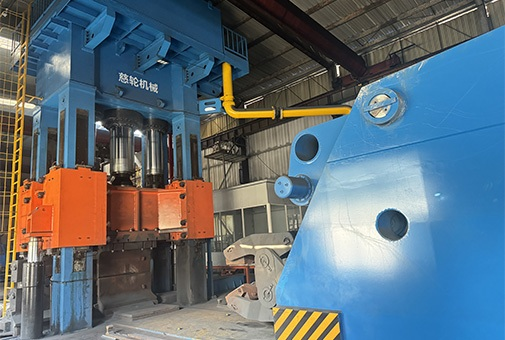
Forging Press
Electroslag welding (ESW) is a highly specialized welding process used primarily for thick, large, and complex metal components. It involves creating an electric arc through a molten slag pool to melt and fuse metal parts together.
Forging a centrifugal impeller is a critical process in aerospace, oil & gas, power generation, and high-performance automotive industries. The press used must deliver precision, high force, and control to create the complex geometry and superior material properties required.
Why Forge an Impeller?
Centrifugal impellers operate at high rotational speeds under extreme stress, temperature, and pressure (e.g., in jet engines, compressors).
Grain Flow: Forging aligns the metal's grain structure to follow the impeller's shape, dramatically increasing fatigue life and strength.
Material Integrity: Eliminates voids and porosity common in castings.
Superior Mechanical Properties: Achieves higher strength-to-weight ratios than casting or machining from billet.
The Forging Process for an Impeller (Typical Steps on a Press)
Billet Preparation: A cylindrical billet of superalloy (e.g., Ti-6Al-4V, Inconel 718) is heated to the precise forging temperature (can be 900°C - 1100°C+).
Pre-forging (Upsetting/Preforming): The hot billet may be upset to create a pancake and then pre-formed to distribute material close to the final shape, saving energy and die wear.
Blocker Forging: The first rough impression die forms the basic hub and blade profiles.
Finisher Forging: The final, precise die set forms the net or near-net shape. This is where the press's control is critical to fill thin, complex blade tips and shrouds.
Trimming & Cooling: Flash is trimmed off in a separate press. The forging is then cooled under controlled conditions.
Heat Treatment & Machining: Extensive heat treatment (solution treating, aging) is performed. Final precision CNC machining is done on the hub, bore, and blade surfaces.
Contact Information
- Tel
+86 17821620679
- Address
No.188 Road Chunhe,
Baoshan District, Shanghai China
